
English


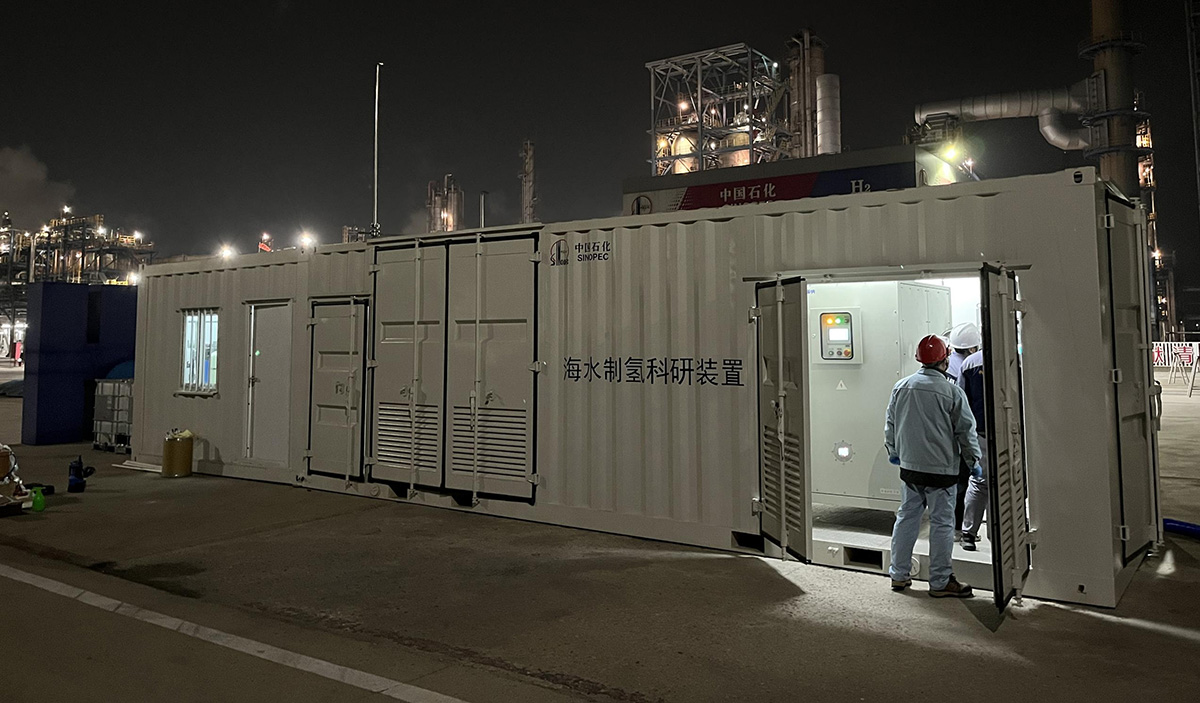
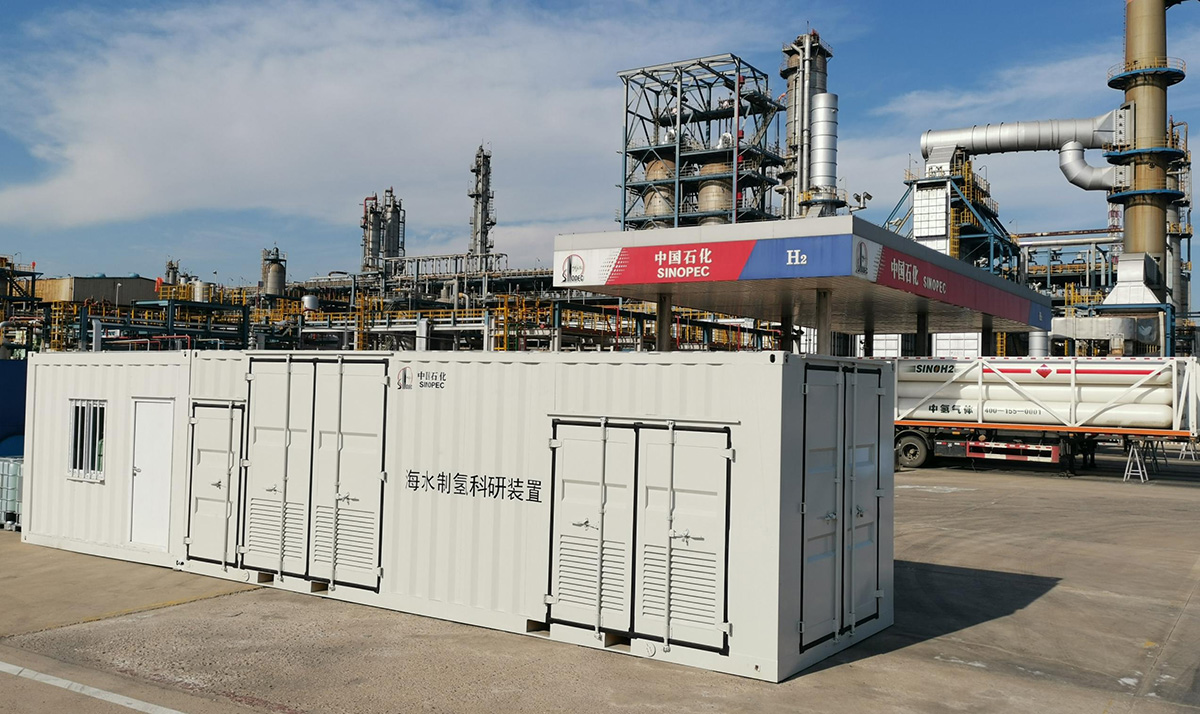
On December 16th, according to China Petrochemical, China's first factory-scale research project for producing hydrogen from seawater has been completed in Qingdao. The completion of this project not only provides an exploration solution for the consumption of renewable green electricity to produce green hydrogen in coastal areas, but also offers a new possible path for the resource utilization of high-salinity industrial wastewater.
China's first factory-based hydrogen production project using seawater has been completed.
The project adopts a model combining direct hydrogen production from seawater and green hydrogen production from green electricity. It utilizes the green electricity generated by the solar power station on the water surface of Qingdao Refining and Chemical Company, and uses electrolyzers to decompose seawater into hydrogen and oxygen, achieving direct electrolysis of seawater to produce green hydrogen. The produced hydrogen is integrated into the pipeline system of Qingdao Refining and Chemical Company and is used to blend into the refining process or be used for hydrogen vehicle refueling. The project has overcome key technical challenges such as chlorine-resistant electrode technology, high-performance electrode plate design, and seawater circulation system.
Liang Feng, a senior expert in the development planning of Sinopec Qingdao Refining and Chemicals: This project can produce 20 cubic meters of green hydrogen per hour. It is the first of its kind in China to directly implement this in a petrochemical park and to achieve the recycling of the produced hydrogen for use in industrial processes, being a 100-kilowatt factory-scale seawater hydrogen production project.
The traditional electrolysis water-splitting hydrogen production technology is highly dependent on scarce clean freshwater resources, which poses a limitation on the large-scale development of the hydrogen energy industry. Meanwhile, seawater hydrogen production faces even more complex challenges: approximately 3% of the salt content in seawater and the chloride ions in impurities can cause corrosion to the electrodes of the electrolysis equipment, while the deposition of cations may clog the equipment channels, reducing the electrolysis efficiency and even damaging the equipment. All these pose higher requirements for equipment design and technical processes.
Liang Feng introduced that by developing and designing specially-made key equipment and implementing unique process flows, they aimed to solve the aforementioned problems. The produced hydrogen was connected to the grid nearby, achieving a high-level coupling and interconnection between scientific research and application scenarios. The project also explored the recycling and utilization of process products during the experiments, reducing the release losses in the process, and has a good exemplary and leading role in protecting the environment, energy conservation, and consumption reduction.
The number of hydrogen energy patents ranks first in the world.
China is accelerating the research on seawater hydrogen production technology.
In the context of global energy transition and climate change mitigation, hydrogen energy, as a clean and efficient energy carrier, is gradually becoming a research hotspot in the global energy sector. And the seawater hydrogen production technology, as an innovative method for hydrogen production, has also attracted widespread attention. In recent years, China has initiated relevant research work in the field of seawater hydrogen production technology and has made progress, and is accelerating the industrialization process.
The coastal areas and waters of our country are rich in wind energy, solar energy and seawater resources, possessing the resource advantage of generating green electricity and producing green hydrogen. By directly electrolyzing seawater to produce hydrogen, the unstable and difficult-to-store green electricity resources can be locally converted into relatively easy-to-store and consume green hydrogen resources. There is no longer a need to occupy a large amount of precious fresh water resources, thus opening up a new path for the efficient utilization of green electricity in coastal areas and the development of the hydrogen energy industry at sea.
Lin Weibin, director of the Energy Policy Research Office of the China Energy Research Society: China has the largest installed capacity of renewable energy in the world. By 2030, the installed capacity of hydrogen production from renewable energy may exceed 100 million kilowatts. By 2060, the production volume of green hydrogen may approach 100 million tons. The installed capacity for generating electricity using hydrogen energy may also exceed 100 million kilowatts.
With the continuous improvement of technology and the gradual reduction of costs, the seawater hydrogen production technology is expected to achieve large-scale industrial application in the future. Currently, China is accelerating the research on seawater hydrogen production technology. Domestic universities and research institutions are actively conducting technological research in the field of seawater hydrogen production. The National Development and Reform Commission and the National Energy Administration released the "Medium and Long-Term Development Plan for Hydrogen Energy Industry (2021-2035)" in 2022, proposing to promote the research and development of new technologies related to hydrogen energy, including seawater hydrogen production. Currently, China ranks first in the world in terms of hydrogen patents, and breakthroughs have been made in technologies such as green hydrogen production, hydrogen fuel cells, and control systems for large-scale hydrogen refueling stations.


